How I work
Build small, judge by numbers,
keep a record that compounds.
I believe a design leader's job is less about one good screen and more about building a way of working that keeps producing them. I refined it leading teams of 6 to 25 in large organisations, and I run my studio this way every week.
From choosing the problem to keeping the record, I run six steps every week.
- 1
Read the numbers
From a metric tree that splits weekly revenue into new visits, conversion rate, order value and orders per buyer, and from the step-by-step funnel, I pick the biggest leak.
- 2
Write the hypothesis
Before changing anything, I write what will change, the primary metric, the guardrails, the decision date and the stop criteria in the change log. One test per surface at a time.
- 3
Build it myself
I do not stop at mock-ups. I build working screens with Claude Code, so reviews happen on screens you can hold in your hand, not on static images.
- 4
Review on real screens
I set the release checks before launch and review phone captures down to overflow and line breaks. I sign off every payment screen from the captures, and feedback left on the review page goes straight to whoever made the screen.
- 5
A/B test
Traffic is split into two groups by device and compared over the same period, with the primary metric and the guardrails watched together. With small samples, I roll out only when every metric points the same way.
- 6
Decide and record
I roll the change out or revert it, and every Monday I group the week into what changed, what happened, what I learned and what comes next. As the record builds up, the next decision comes faster.
I set principles first, so the team judges by the same standards.
Show things as they are
Show only the prices and terms that actually apply. One honest line sold more than a dressed-up discount.
Paldo Saju +61%Give before you ask
Before any step that asks something of users, put something they get first.
Paldo Saju conversion 5.8% → 9.2%AI acts only after approval
When AI acts on a user's behalf, it does so only after the user confirms, and every action is recorded.
Anees, Abu Dhabi GovernmentThe same wherever you look
Same data, same sentences, same renderer. Consistency is made in the system, not on the screen.
memory.wikiOne test per surface at a time
Any surface where money is at stake gets a single experiment, and the decision criteria are set before it goes live.
Paldo Saju, lesson 04From design to launch and operations, I work with AI as part of the team.
I build products myself with Claude Code, from screen design through to launch. Operations are run by AI agents, each given its own role: around 50 across the studio, around 30 of them on Paldo Saju. One agent sets priorities, one alone holds deployment rights, and agents for finance, data, the funnel and pricing each work in their own lane.
People decide three things: prices, new paid channels and budget increases. Agents cannot go past the daily ad cap, the loss cap or the limits on budget changes (20% up, 30% down). Review feedback is left right on the page, and it goes straight to the agent that made it.
Tools I use now
- Claude Code
- Prototypes on the real app code
- In-house A/B test allocation and decisions
- Change log
- Review pages and feedback routing
The agents ask through reports, and I answer on the page.
The funnel, finance and pricing agents send reports on a set schedule, and before a screen changes, they make a review page that sets the options side by side.
At the top of every page it says which agent is waiting for feedback, when the page was made and when it was last changed. Feedback written in the box at the bottom right goes straight to the agent that made the page, and any sentence selected on the page goes with it as a quote. With dozens of agents, it means I never have to wonder where to reply.
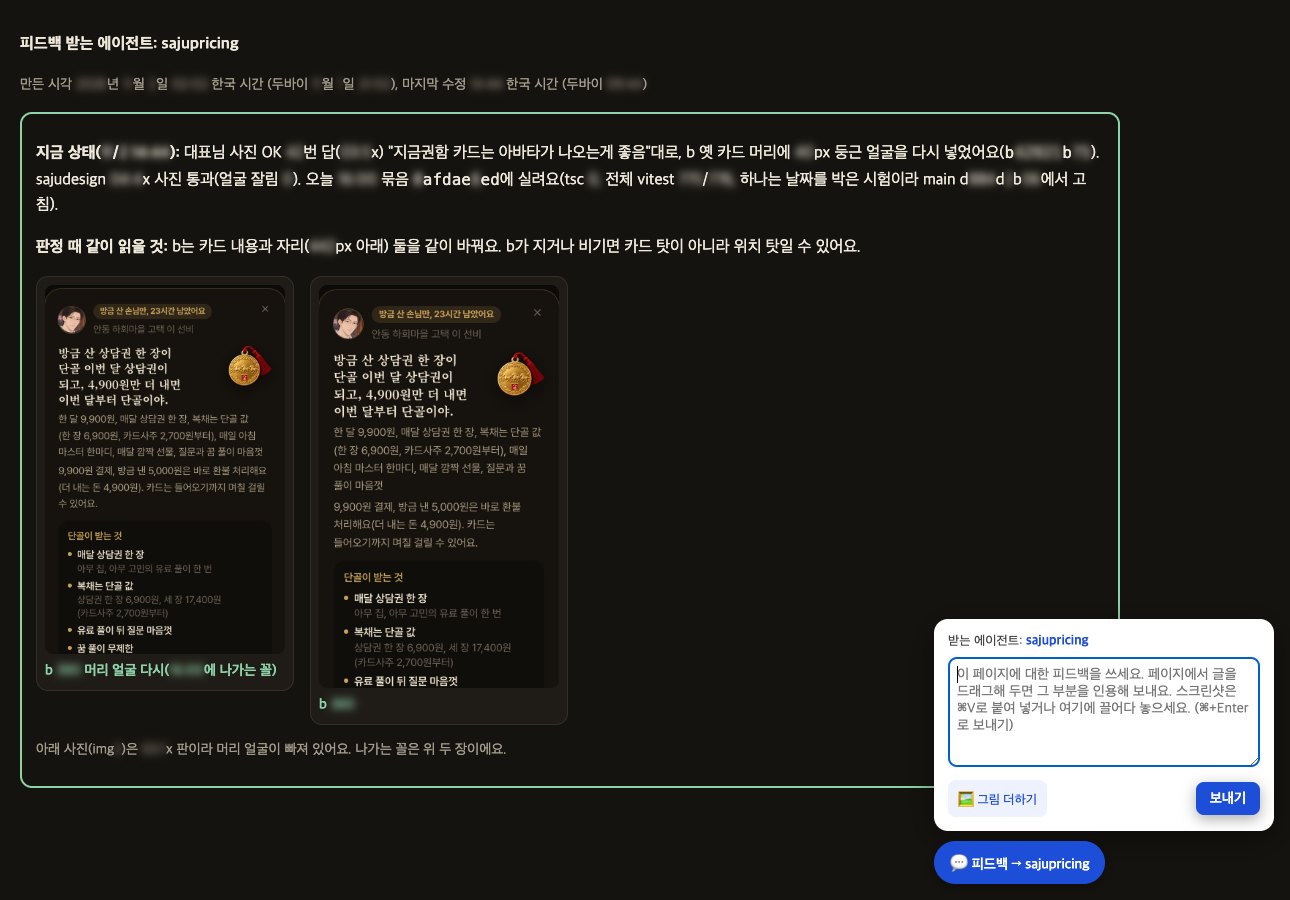
A real review page. The numbers are hidden.
From 6 to 25 people, I have built teams from scratch and led them.
Abu Dhabi DGE, Product Experience Lead
At the Department of Government Enablement (DGE), I lead experience design for two government AI products. Anees prepares and records meetings and turns them into decisions and actions. It sends follow-up emails and tasks only after the user approves, and records every action. It runs on UAE sovereign cloud. In Wakeel, AI reads a senior decision-maker's pending approvals first and recommends a decision.
Humain, AI Product & Experience Lead
Built and led a six-person experience team for Humain One, Saudi Arabia's national AI platform, from the ground up, and set its product vision, experience principles and review system. Designed the first experience of someone new to AI handing real work to an agent.
Devsisters, Group Director
Proposed a VR business and secured its budget, built a 25-person team across project management, engineering, art and marketing, and launched a CookieRun VR game on the Meta Quest Store. Negotiated the company's first partnership with Meta.
Kakao IX Europe, Regional Director
Set up Kakao's first European subsidiary with a team of eight, and introduced Kakao Friends to Europe through licensing and retail partnerships.
Saudi Aramco, UX Lead
Led a 12-person UX team to create a company-wide design system and UX guidelines, and applied them across several business units. Designed the whole digital journey that helps Saudi women get their first driving licence.
AKQA and Razorfish, London
Led UX for Nike (NRC, NTC), Volvo, Barclays, Virgin Atlantic and Hello Bank! from BNP Paribas.